

Singapore is often described as a modern city-state, cosmopolitan, at the crossroads of cultures. But behind the skyscrapers of Marina Bay and the symmetries of the colonial district, there is a rich and often little-known Islamic history. How did Islam establish itself in Singapore? Which key figures shaped the Muslim community of this small territory that became a global economic hub? A journey to the heart of a history worth telling, to the History of Islam in Singapore
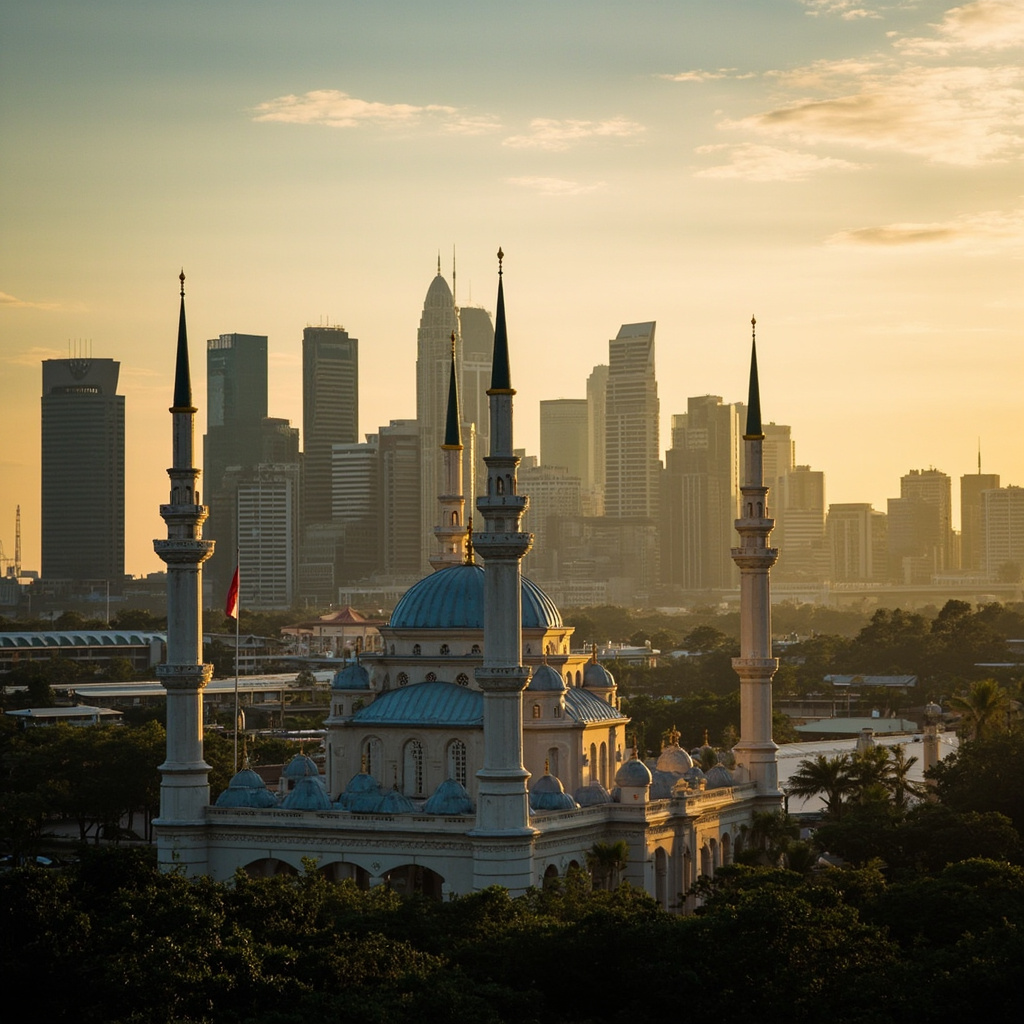
The Malay origins: before British Singapore
Well before the arrival of the British in 1819, the island of Singapore — then known as Temasek (which means « sea city » in Malay) — was already a strategic trading post. The local populations were of the Malay-Muslim faith, with close trade links with the sultanates of Johor, Kedah, and Pattani.
The first documented Islamic establishment in Singapore dates back to the 13th century, with traces of the presence of Arab and Gujarati merchants who brought Islam to the region. The Malay language, spoken by the local populations, already bore the marks of this influence.
Sir Stamford Raffles and the founding of modern Singapore (1819)
In 1819, Sir Stamford Raffles, an agent of the East India Company, landed in Singapore and signed a treaty with the sultan of Johor, Sultan Hussein Shah, to establish a British trading post. This treaty is crucial for the Islamic history of Singapore: it recognizes Sultan Hussein Shah as the legitimate sultan of Singapore, thus establishing a Malay-Muslim monarchy on the territory.
Raffles designed the city with a true multi-ethnic vision: Chinese district (Chinatown), Indian district (Little India), Malay district (Kampong Glam). The latter became the heart of Singapore’s Malay and Muslim community, and remains so today.
Kampong Glam: the cradle of the Muslim community
Kampong Glam is the historic district of Singapore’s Malay and Muslim community. This is where Masjid Sultan (Sultan Mosque), one of the oldest mosques in Singapore, is located — built in 1824 thanks to the funds of Sultan Hussein Shah. Surrounded by narrow lanes and traditional shops, Kampong Glam is a living testament to Singapore’s Islamic history.
The district retains a special atmosphere: traditional Malay architecture coexists with modern cafes, textile shops, and halal restaurants. It is a neighborhood where religious history can be read in every street.
To discover Kampong Glam and its surroundings, check our page Singapore — Muslim Friendly Guide to the City-State.
The Indian-Muslim community: Chulia Kampong and Masjid Malabar
A significant part of Singapore’s Islamic history was written by Indian Muslims, mainly from the Chulia (merchants from southern India, Tamil Nadu) and Malabaris communities. These merchants established their own neighborhoods and built their own mosques. This is also part of History of Islam in Singapore.
The Masjid Malabar (also known as Masjid Jamiyah Malabar), located in the Kampong Glam district, bears witness to this heritage. Built in 1840, it is one of the oldest mosques in Singapore, reflecting Indo-Islamic architecture with its distinctive domes and minarets.
Singapore’s significant Indian-Muslim community helped make the city-state a major economic center for trade between India, the Arab world, and China.
The Japanese occupation and Malay resistance (1942-1945)
During World War II, the Japanese occupation of Singapore (renamed Syonan-to, « light of the south ») was a dark period for the Muslim community. The Japanese tried to divide communities by promoting Islam as a religion separate from others, creating tensions with the Chinese and Indian communities.
After liberation, Singapore’s Malay-Muslim community played a central role in the founding of independent Malaysia (1957), and then in the negotiations that led to Singapore’s withdrawal from the Federation of Malaysia in 1965, under the leadership of Lee Kuan Yew — whose government always maintained a strict policy of religious tolerance.
Independent Singapore: a model of religious coexistence
Today, Singapore is a secular state but where religious freedom is guaranteed by the Constitution. Muslims represent about 15% of the population (approximately 800,000 people), making Islam the second religion in the country after Buddhism.
The Singaporean government has set up a sophisticated religious management system: the Islamic Religious Council of Singapore (MUIS) manages Islamic religious affairs, issues halal certifications, and oversees mosques. Singapore’s mosques are regularly maintained and play an important social role (education, social work, marriage).
The iconic mosques of Singapore to visit
Singapore has more than 70 mosques. Among the most remarkable:
- Masjid Sultan (Kampong Glam) — the most famous historic mosque, with its golden domes
- Masjid Malabar — 19th century Indo-Islamic architecture
- Masjid Ba’alwie — spiritual center of Singaporean Muslims, housing the tomb of Sheikh Ahmad
- Masjid Angullia — art deco architecture meets Mogul influences
- Masjid Hajjah Fatimah — named after a 19th century Malay businesswoman
Check our page Mosques in Asia — The Most Beautiful Mosques of Indonesia and Malaysia for a broader overview including neighboring mosques.
Getting there: flights and halal accommodation
Singapore is accessible by direct flight from Paris (about 13 hours of flight). Changi Airport, regularly elected the world’s best airport, is a spectacular gateway to this micro-state. And discover History of Islam in Singapore.
Paris to Singapore Flights
See Paris – Singapore flights → (*)
Direct flight Paris CDG → Singapore Changi (SIN)
For your stay, here are our recommendations for halal-friendly hotels near Kampong Glam and the Islamic district:
Halal-friendly hotels near mosques · Trip.com Partners
Eating halal in Singapore: a well-adapted city
Finding halal food in Singapore is relatively easy thanks to the diversity of the population. Malay, Indian, and Arabic restaurants offer halal dishes. Halal certification is rigorous and certified restaurants bear the MUIS Halal logo (Islamic Religious Council of Singapore).
Check our page Halal Restaurants in Asia — Indonesia and Malaysia for recommendations beyond Singapore.
What about discovering the religious history of the region?
Singapore is the ideal starting point for exploring the Islamic history of Southeast Asia. From there, you can easily reach:
- Peninsular Malaysia — Kuala Lumpur, Malacca (cradle of Islam in Malaysia) — see Malaysia Halal
- The Indonesian states of Sumatra and Java — the history of the Wali Songo — see Indonesia Halal
- Saudi Arabia to perform Umrah — see Umrah Rites on UmrahOnTheGo
And for those who wish to truly walk in the footsteps of history, did you know that Umrah in June after Hajj offers an experience of particular spiritual intensity? Fewer crowds, more contemplation. Discover the UmrahOnTheGo article on the subject.
Resources
Smart Islamic home
For a connected home adapted to the Muslim lifestyle, explore the Domobayt guides.
Book your activities in Singapore:
– Excursions and guided tours on Klook → (*)
– Mosque tickets and Islamic sites on Klook → (*)
Guided tours with GetYourGuide:
– Discovery tours on GetYourGuide → (*)
– Halal experiences in Asia on GetYourGuide → (*)
SIM and eSIM for traveling in Asia:
– Asia Halo eSIM — unlimited data on Airalo → (*)