

Indonesia is the most populous Muslim-majority country in the world — over 230 million faithful, most of whom live on the island of Java (Jawa). Yet the history of Islam in Java is far from linear. Before the arrival of Islam, Java was Hindu-Buddhist, as evidenced by the extraordinary temples of Borobudur and Prambanan. How did Islam conquer this island? How did it establish itself to become the religion of 95% of the Javanese population? Dive into 7 centuries of Islamic history in Java. Welcome to History of Islam in Java.
The origins: Islam arrives by sea (13th century)
Islam arrived in Java through the north coast of the island, carried by Arab, Indian, and Chinese merchants who had already been trading with the Hindu kingdoms of Java since the 8th century. The first to bring Islam were merchants from Gujarat (India) and Yemen, established in the ports of the north coast: Pasai (Sumatra) and the trading posts of eastern Java.
The first Islamic sultanate in Java is the Sultanate of Demak, closely linked to the rise of Malacca (founded around 1478), often considered the cradle of Islam in Java. Its first sultan, Raden Patah (also called Sultan Trenggana), is said to have been a Hindu prince converted to Islam. Demak quickly became the nerve center for the spread of Islam throughout central and eastern Java.
The Wali Songo: the 9 Saints who Islamized Java
This is where the central figure of Javanese Islamic history comes in: Wali Songo (Wali Sangå — the 9 Saints). These nine preachers and mystics, active during the 15th and 16th centuries, are considered the pillars of the Islamization of Java. Their approach was remarkable: instead of rejecting local practices, they adapted and reinterpreted them within an Islamic framework.
The 9 Wali Songo:
- Sunan Giri (Raden Paku) — East Java, spread through maritime trade
- Sunan Ampel (Raden Rahmat) — Surabaya, author of the Serat Centhini
- Sunan Bonang (Raden Makdum Ibrahim) — Tuban, East Java, known for his music and arts
- Sunan Kudus (Ja’far Shadiq) — Kudus, integrated Hindu traditions from Borobudur Temple
- Sunan Kalijaga (Raden Said) — the most famous leader, syncretic genius
- Sunan Muria (Raden Umar Said) — Mount Muria, active in the east
- Sunan Gunung Jati (Syarif Hidayatullah) — Cirebon and Banten
- Sunan Drajat (Raden Qasim) — coastal Java
- Sunan Giri Ngundrangi — administration and da’wa
Their legacy is everywhere in Java: from ancient mosques to the traditions of wayang (shadow puppet theater) reinterpreted with Islamic stories, to tahlilan (collective prayer for the deceased) that blends local customs with Islamic rites.
The Sultanate of Mataram: the golden age of Islam in Java (16th-18th century)
The Sultanate of Mataram, founded in the 16th century in central Java, represents the political peak of Islam in Java. It was under Mataram that Java reached its greatest territorial expansion. The Mataram court perpetuated the syncretic tradition of the Wali Songo while consolidating a structured Islamic state.
The sultanates of Cirebon, Banten, and Mataram coexisted, each leaving considerable architectural heritage: historic mosques, tombs of the sultans, and a vibrant Islamic artistic tradition.
Masjid Al-Azhar: Jakarta’s jewel
In contemporary Jakarta, Masjid Al-Azhar (also known as Masjid Jami’ Al-Azhar) is one of the most emblematic places of worship. Founded in 1958, this mosque stands out for its architecture that blends Javanese and Middle Eastern influences, with its elegant minarets and main dome.
Jakarta also features Masjid Jami’ Anwar, Masjid Agung Sunda Kelapa, and many other historic mosques. Check our page Mosques in Asia — The Most Beautiful Mosques of Indonesia and Malaysia for a complete overview.
When Java became Hindu-Buddhist again — the Borobudur paradox
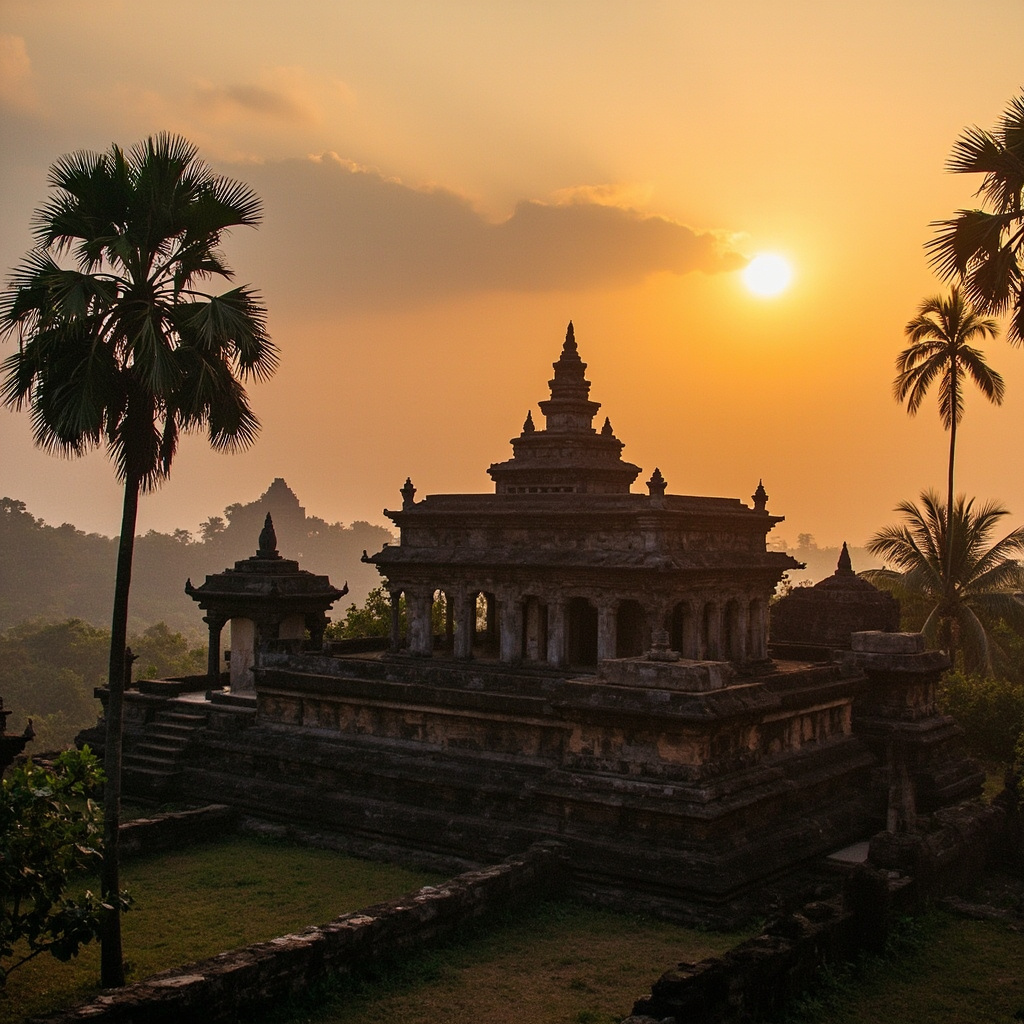
The contrast between Java’s Islamic history and its Hindu-Buddhist past is striking. The temple of Borobudur (8th century), the largest Buddhist monument in the world, was abandoned in the 15th century, precisely when Islam was gaining Java. The temple of Prambanan, dedicated to the Hindu trinity Shiva, Vishnu, and Brahma, bears witness to this period.
This religious stratigraphy — Hinduism, Buddhism, then Islam — gives Java exceptional spiritual depth. Even today, Javanese can be devout Muslims while practicing ancestral rites that bear the imprint of these earlier eras.
Muslim Indonesia today: Jakarta, Java, and daily life
Jakarta, the capital of Indonesia, is a bustling metropolis where mosques coexist with skyscrapers. The five daily prayers shape the day: at 4:30 AM, 12 PM, 3:30 PM, 6 PM, and 7:30 PM, muezzins call from the minarets, creating a unique spiritual symphony in the world.
To discover Java today, explore our Indonesia guide and our Jakarta guide:
- Jakarta — Muslim Friendly Guide to the Indonesian Capital
- Yogyakarta — Javanese Culture and Muslim Friendly Cuisine
- Bandung — The Creative City of West Java
Getting there: flights and halal accommodation
Java is served by Soekarno-Hatta International Airport in Jakarta (CGK), with direct flights from Paris via several carriers. It is the natural gateway to explore the island.
Paris to Jakarta Flights
See Paris – Jakarta flights → (*)
Direct flight Paris CDG → Soekarno-Hatta Airport (CGK)
For your stay in Jakarta, here are our recommendations for halal-friendly hotels near mosques and the city center:
Book a halal-friendly hotel in Jakarta · Trip.com Partners
Why not take a pilgrimage along the way?
The history of the Wali Songo in Java was written by men who traveled across the island, preaching, building mosques, and leaving a spiritual imprint at every step. Their tombs (or makam) are still visited today by Javanese faithful who follow in their footsteps.
If this history moves you, did you know it is entirely possible to walk in their footsteps by performing your Umrah? Unlike the pilgrimage to Mecca which attracts millions each year, doing your Umrah in June after Hajj offers a much more intimate and contemplative experience — in calm, around the Kaaba, in the footsteps of millions of pilgrims through history. Discover why do your Umrah in June after Hajj — less crowds, more reflection.
Other Islamic sites in Java and Sumatra
Beyond Jakarta and Yogyakarta, Indonesia abounds in remarkable Islamic sites:
- Makam Sultan Banten (Banten) — Funerary complex of the Sultanate of Banten, West Java
- Masjid Agung Demak — One of the oldest mosques in Java, founded in the 15th century
- Masjid Cheng Ho (Surabaya) — Mosque named after Chinese admiral Cheng Ho, symbol of interreligious dialogue
- Islamic Site of Aceh (Sumatra, but spiritually close to Java) — Cradle of Islam in Indonesia
I hope you have enjoy this overview of history of Islam in Java.
Resources
Connected home: Automate your home with a local AI assistant. Compare solutions on Lunarok-domotique.com and discover Domobayt.com for a smart home.
Book your activities in Indonesia:
– Excursions and guided tours on Klook → (*)
– Mosque tickets and Islamic sites on Klook → (*)
Guided tours with GetYourGuide:
– Discovery tours on GetYourGuide → (*)
– Halal experiences in Asia on GetYourGuide → (*)
SIM and eSIM for traveling in Asia:
– Asia Halo eSIM — unlimited data on Airalo → (*)
[…] Voyage halal en Asie du Sud-Est : guide complet sur AsieHalal […]